

FITTING A MODEL TO SINGLE-RECORD-PER-EVENT INTERVAL-CENSORED DATA
Consider a fictional dataset simulated based on the Atherosclerosis Risk in Communities (ARIC) study described in Xu, Zeng, and Lin (2023). This dataset comprises 200 subjects, each from one of four US communities. The participants were followed over time and assessed for both diabetes and hypertension during several follow-up examinations. Because the subjects were examined only periodically, the exact onset times of these diseases were not observed, but they are known to fall in intervals between doctor visits. Two variables, ltime and rtime, capture this information by recording the last examination time before the event occurred and the first examination time after the event, respectively.
We wish to identify the factors that influence the times to onset of diabetes and hypertension. The factors of interest include three demographic variables—race, sex (male), and community—and five baseline risk factors: age (age), body mass index (bmi), glucose level (glucose), systolic blood pressure (sysbp), and diastolic blood pressure (diabp). The dataset contains one record per event per subject with the event-time information recorded as interval data. This type of data is called single-record-per-event interval-censored data. Here is a subset of the dataset for subjects 91 and 92:
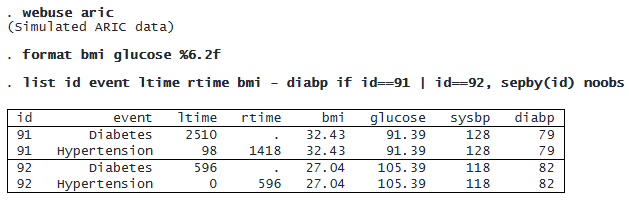
We can fit a marginal Cox proportional hazards model in which the times to onset of diabetes and hypertension depend on the above factors of interest. In a single-record-per-event format, we must specify the id(), event(), and interval() options. The command performs intensive computations and may take a little longer to run.
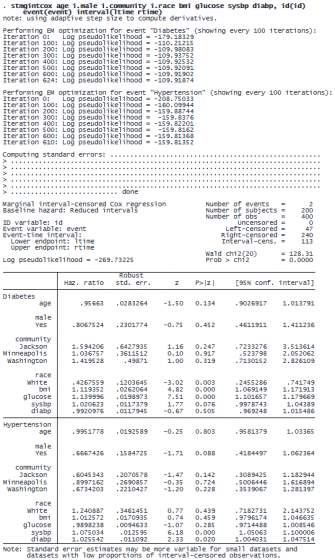
The header above the coefficient table gives a summary of the censoring information. In the diabetes output, we notice that White individuals have a lower risk of diabetes. Additionally, higher body mass index and elevated glucose levels are associated with a higher risk of diabetes. In the output for hypertension, we see that higher systolic and diastolic blood pressure are associated with a greater risk of hypertension.
FITTING A MODEL WITH EVENT-SPECIFIC COVARIATES
From the model above, we can see that body mass index and glucose level are key risk factors for diabetes but not for hypertension. On the flip side, systolic and diastolic blood pressure appear to be important factors for hypertension but not for diabetes. Therefore, we can use different sets of covariates to model these two events. We also use the nolog option to suppress iteration logs and the favorspeed option to speed up computation.
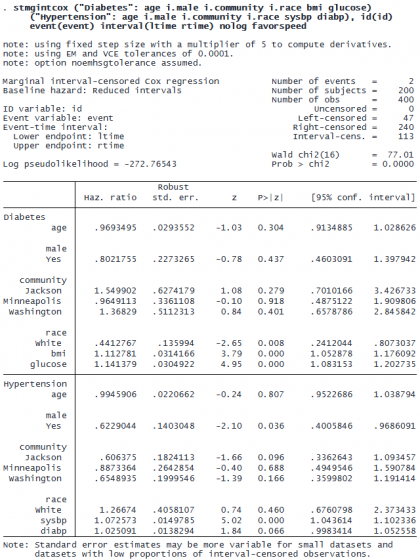
Because age, male, community, and race are common covariates for both events, we can also specify the model by using a combination of common covariates and event-specific covariates:

Both of the above specifications will give us the same result.
ESTIMATING AND TESTING THE COMMON EFFECT OF A COVARIATE ACROSS ALL EVENTS
After fitting the above model, suppose we want to test the hypothesis that the effects of age are zero for all events. We can use the estat common command to estimate an optimal weighted average effect of age across all events and conduct a z test to determine whether this average effect is zero under the null hypothesis.

We fail to reject the null hypothesis that the weighted average effect of age across all events is zero (the p-value is 0.518). When the effects are similar across different events, the average affect estimates the common effect, and this test is more powerful than the traditional multivariate Wald test, which can be performed with the test command.
© Copyright 1996–2026 StataCorp LLC. All rights reserved.
GRAPHING SURVIVOR FUNCTIONS
We can use stcurve to plot the estimated survivor functions. By default, the stcurve command with the survival option evaluates the survivor functions at the overall means of covariates for each event and plots the survivor functions for both events as subgraphs.

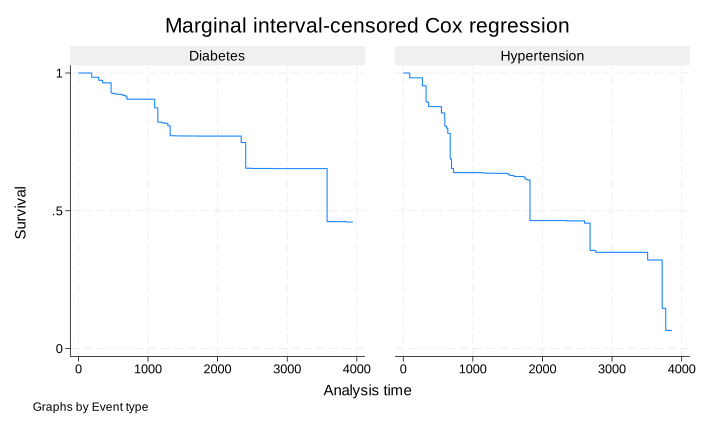
We can add the sepevents option to request that the estimated survivor function for each event be displayed on a separate graph.
If we wish to compare the survival curve of an average person with diabetes across different communities, we can specify multiple values for community using the at() option and specify the event value label “Diabetes” in the events() option.

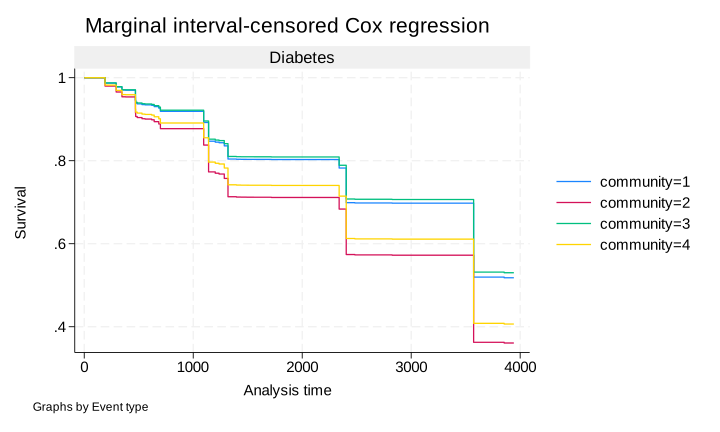
The above survival curves show that an average person in Forsyth (blue line) and one in Minneapolis (green line) have a similar higher risk of developing diabetes, whereas an average person in Washington (yellow line) and one in Jackson (red line) have a lower risk of developing diabetes.
ASSESSING OVERALL MODEL FIT WITH GOODNESS-OF-FIT PLOTS
We can use the estat gofplot command to produce the event-specific goodness-of-fit plots and visually assess the overall model fit. estat gofplot calculates an empirical estimate of the cumulative hazard function based on the Cox–Snell-like residuals for each event and plots the resulting cumulative hazard rate against the residuals themselves. If the model fits the data, those plots are expected to remain close to the reference line.

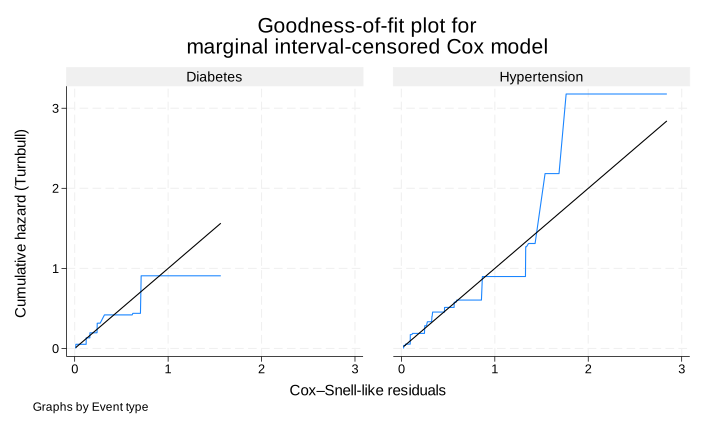
By default, estat gofplot displays all event-specific goodness-of-fit plots as subgraphs within a single graph. The plot on the left indicates that the marginal Cox proportional hazards model fits the data well for diabetes. The plot on the right suggests that the marginal Cox model fits the data mostly well for hypertension, except for the tail, which deviates from the reference line because of an outlier.
FITTING A MODEL TO MULTIPLE-RECORD-PER-EVENT INTERVAL-CENSORED DATA
Interval-censored data can also be recorded in multiple-record-per-event format. In this format, each event for a subject may contain multiple records with multiple examination times and potential TVCs at each examination time. Here we use an extended version of the previous dataset. It contains all the baseline covariates as well as four time-varying covariates: bmi, glucose, sysbp, and diabp. It also records the examination time (time) and whether the event occurred since the last examination (status). Here is a subset of this dataset for subjects 91 and 92:
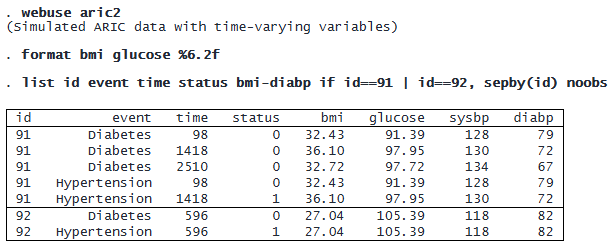
We use stmgintcox to fit a marginal Cox proportional hazards model in which the times to onset of events (diabetes and hypertension) depend on baseline covariates age, male, community, and race and TVCs bmi, glucose, sysbp, and diabp. In a multiple-record-per-event format, we must specify the id(), event(), time(), and status() options. We also include the detail option to get detailed censoring information for each event.
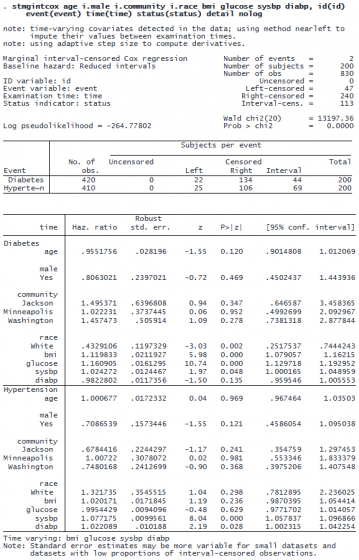
After accounting for time-varying risk factors, we see that elevated glucose levels, a higher body mass index, and elevated systolic blood pressure are associated with an increased risk of diabetes onset. Race White is associated with a lower risk of developing diabetes. Also, elevated systolic and diastolic blood pressure levels are associated with a higher risk of developing hypertension.