
ONE INSTRUMENT
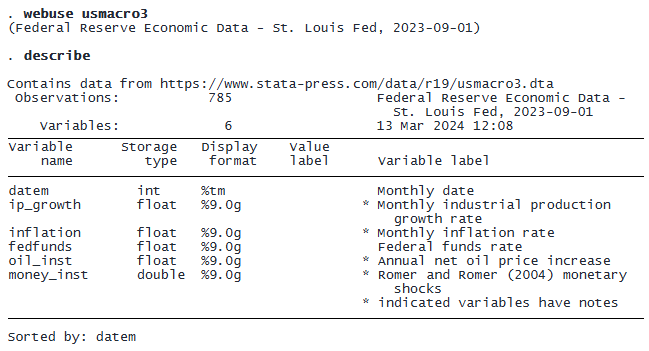
We have data on outcome variables for industrial production growth (ip_growth), inflation, and interest rate (fedfunds).
A VAR model for these three variables includes shocks to industrial production growth, inflation, and the interest rate. We are interested in the effect of an inflation shock. We use an oil price measure, oil_inst, as proxy for the inflation shock. The inflation shock is then called the target shock, and we estimate the effects of this shock. The effects of noninstrumented shocks are not estimated. No restrictions are needed because we have only one target shock.
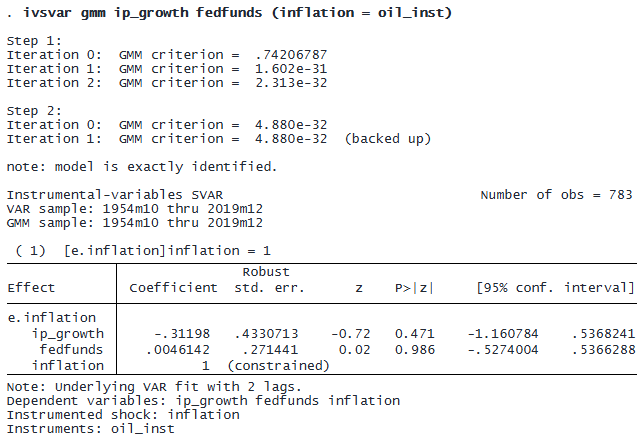
There are three coefficients, one each for the impact effect of an inflation shock on industrial production growth, on the interest rate, and on inflation itself. The inflation response is normalized to one, so the other two responses can be interpreted as the relative response to a shock that raises inflation by one unit. On impact, the inflation shock reduces industrial production growth and slightly raises the interest rate. However, we do not have enough evidence to conclude that either impact effect is different from zero.
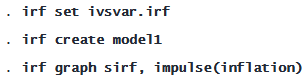
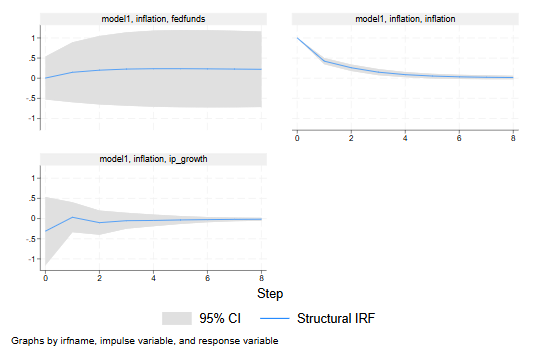
The dynamic effects trace out the effect of the shock over time. To compute dynamic effects, we compute and graph IRFs.
© Copyright 1996–2026 StataCorp LLC. All rights reserved.
The IRF graph plots the response of each variable to the inflation shock. Eight periods of responses are shown; because these data are monthly, eight periods represents eight months.
MULTIPLE INSTRUMENTS
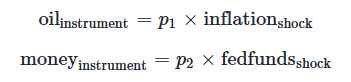
ivsvar mdist allows multiple instruments to proxy for multiple target shocks. Because there are multiple target shocks, we need to supply some restrictions. We provide Stata with a matrix describing how the instruments are related to the target shocks. Say we have two instruments: an oil price and a monetary policy instrument. We think these instruments are related to the inflation shock and the interest rate shock, respectively. Our theory is
In Stata, we could set up this relationship as

where the first dot (.) represents parameter p1 and the second dot represents parameter p2. By specifying a dot, we instruct ivsvar to estimate the corresponding parameters. And we assume that the two cross-effects, the effect of the interest rate shock on the oil price and the effect of the inflation shock on the monetary policy instrument, are zero.
We estimate the impact effects with
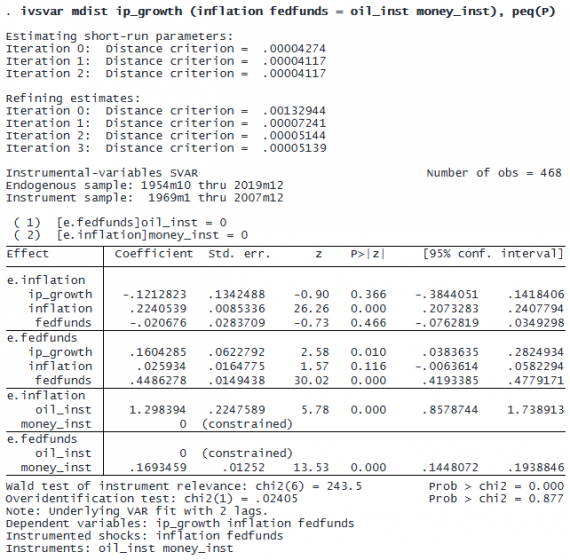
The output table is organized by the impact effect of each shock. The first output block displays the impact effect of the inflation shock on the model variables: how an inflation shock affects the industrial production growth, inflation, and interest rate. The impact effects here can be interpreted as 1-standard-deviation shocks. An inflation shock slightly reduces industrial production and increases inflation. Unlike in the previous example, the interest rate now falls slightly on impact rather than rising slightly. But we still do not have enough evidence that the impact effects of the inflation shock on ip_growth and fedfunds are different from zero.
The second block displays how an interest rate shock affects the outcome variables. All three variables appear to rise on impact.
Note that we imposed no restrictions on the impact effects of the shocks on the endogenous variables. All six effects in the first two blocks were freely estimated.
The final two blocks display how each shock affects the two instruments. We have constrained all cross-effects to be zero, so each instrument is affected only by one shock.
If a similar standard short-run SVAR model were fit with svar, constraints would have been placed directly on the impact effects—the first two blocks in the output above. With ivsvar, constraints can be placed on how the shocks affect the instruments, and no constraints are needed on the impact effects.